
1. Kadrey et al. v. Meta
Background: Author Richard Kadrey, comedian Silverman, and others sued Mark Zuckerberg’s Meta on July 7, 2023 in the U.S. District Court (Northern District of California) for mass infringement - i.e., unlicensed “training” of their generative AI model on millions of copyrighted works, including their own. Meta’s defense is “fair use.” The judge assigned is Judge Vince Chhabria.
At first, in November 2023, the Court dismissed the bulk of plaintiffs’ claims against Meta. But the Court gave plaintiffs a chance to amend their complaint to add a more direct link to actual harm - and they filed their amended complaint in December 2023.
Current Status: The Court held the Summary Judgment Hearing. Following the long-awaited oral arguments on summary judgment, the parties engaged in very little docket activity this week. Among the few events that did transpire, the author-plaintiffs filed their objections to Meta’s reply brief evidence. Plaintiffs are objecting to Meta’s declarations in support of its summary judgment as untimely, and asking that they be stricken from the record. Additionally, Plaintiffs’ slide decks from the summary judgment hearing were included on the docket this week. Although they don’t reveal much that wasn’t included in the briefing, one slide does accuse Meta of using the “Bob Marley defense”:
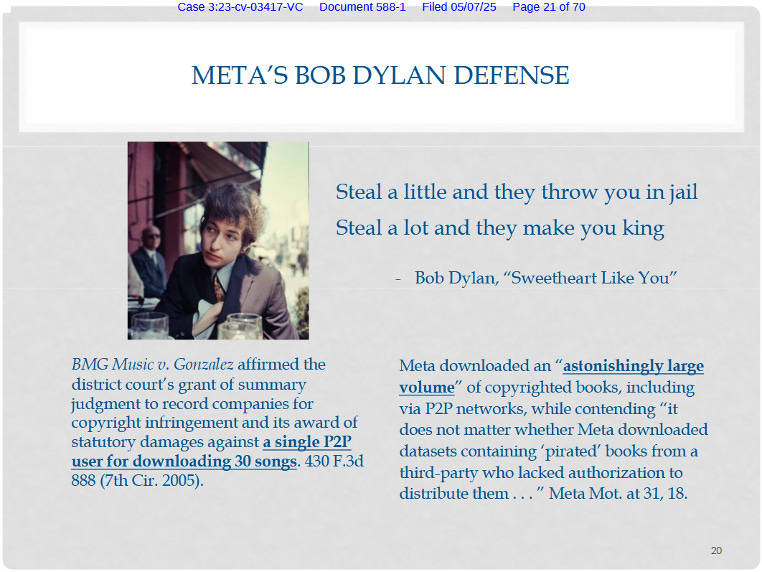
Plaintiffs aren’t totally wrong. Meta’s argument is that by engaging in massive piracy and using the pirated data to train state-of-the-art LLMs, they have done something so transformative as to escape liability for copyright infringement. However, as we discussed last week, it appears that the Court may be less than receptive to the argument that stealing a little and stealing a lot have any dispositive bearing on the “fair use” analysis. We’ll find out when the Court releases its long-awaited opinion on summary judgment.
2. The New York Times v. Microsoft & OpenAI
Background: This is perhaps the single most closely watched litigation involving copyright owners and generative AI tech companies.
On December 27, 2023, The New York Times sued Microsoft and OpenAI in the U.S. District Court for the Southern District of New York for copyright infringement and other related claims. The Times alleges that the companies used “millions” of its copyrighted articles to train their AI models without its consent. The Times claims this has resulted in economic harm by pulling users away from their paywalled content and impacting advertising revenue. The complaint alleges several causes of action, including copyright infringement, unfair competition, and trademark dilution. In its pleadings, The Times asserts that Microsoft and OpenAI are building a “market substitute” for its news and further that their AI generates “hallucinations” based on The Times’ articles also substantially damage its reputation and brand. The Times seeks “billions of dollars of statutory and actual damages.” Microsoft and OpenAI assert the defense of “fair use” - i.e., no license, payment or consent is needed.
On September 13, 2024, the Court granted a motion to consolidate the case with another brought by the Daily News and other publications. The judge assigned to the consolidated cases i Judge Sidney Stein.
Current Status: It’s a discovery status conference and everyone is invited. On May 9th, the Court ordered parties for all actions to attend an in-person discovery status conference on May 27th. Although the conference is a few weeks out, it may be the starting point for more rapid movement on these newly-consolidated cases. Check back soon to find out how that develops. In its order, the Court stated that it would issue a separate order addressing the news Plaintiff’s spoliation concerns.
Additionally, the news Plaintiffs asked the Court for permission to file a supplemental letter to Judge Wang regarding OpenAI’s preservation of chat logs, on which the parties continue to disagree. According to Plaintiffs, OpenAI has failed to retain logs of user interactions with ChatGPT by deleting such logs since the start of the litigation. Plaintiffs’ letter requests a hearing on the issue to ensure that responsive information is preserved.
3. Ziff Davis v. OpenAI
Background: A new combatant enters the fray! Ziff Davis, the parent company to a variety of health and technology media corporations (including Everyday Health, Mashable, and PCMag), recently sued OpenAI for copyright infringement, DMCA violations, unjust enrichment, and trademark dilution. Ziff’s allegations are based on the use of its articles as training data for OpenAI’s LLMs, and additionally include factual allegations that Ziff attempted to follow OpenAI’s instructions to modify its robots.txt file (an informational file served by websites to instruct search engines and other web crawlers in what they can and cannot scrape from the website), but only saw an increase in OpenAI scraping activity when it did.
In addition to copyright infringement allegations, Ziff argues that this improper scraping resulted in the reproduction of its content with copyright information removed — and also enriched OpenAI despite a lack of authorization by or compensation to Ziff. Further, Ziff alleges that OpenAI has exploited the registered trademarks of Ziff’s websites in order to promote itself by providing incomplete, misleading, or even false summaries of content published by Ziff’s subsidiaries.
Current Status: No major substantive developments this past week. Check back here in the future as we continue to track the development of this new litigation.
4. Concord Music Group, et al. v. Anthropic
Background: UMG, Concord Music and several other major music companies sued Amazon-backed OpenAI competitor Anthropic on October 18th, 2023 in the U.S. District Court (Middle District of Tennessee). The music companies assert that Anthropic is infringing their music lyric copyrights on a massive scale by scraping the entire web to train its AI, essentially sucking up their copyrighted lyrics into its vortex – all without any licensing, consent or payment. In its response, Anthropic claimed fair use. The case was transferred to the Northern District of California on June 26th, 2024 and closed in Tennessee. The judge assigned is Judge Eumi K. Lee. The parties have not yet had a case management conference.
Current Status: Anthropic files its motion to dismiss! On April 25th, Plaintiffs filed their first amended complaint following Anthropic’s motion to dismiss their initial complaint. This past week, Anthropic moved to dismiss that amended complaint. Anthropic’s arguments mirror those that it made originally. First, that Plaintiffs have failed to plausibly plead that Anthropic was aware of any likelihood of infringement or of any concrete instance of infringement in order to support their contributory infringement claim. Second, that Plaintiffs’ claims of vicarious infringement fail because they do not actually demonstrate a causal connection between alleged acts of third-party infringement and financial benefit to Anthropic. And third, that Plaintiffs’ DMCA claims fail because they have failed to adequately plead intentional removal of copyright management information with reasonable knowledge that such removal would facilitate infringement.
5. Thomson Reuters v. Ross Intelligence: The “Fair Use” Shot Heard Around The Litigation World
Background: On February 11th, in a case that comes tantalizingly close to deciding the issue of “fair use” in generative AI model training (with many taking the position that now that issue is firmly decided, as laid out below), Circuit Judge Bibas of the District of Delaware ruled that the “fair use” doctrine does not protect the use of West Headnotes in determining what to display as a result of a user query. Thomson Reuters v. Ross Intelligence involves an AI search tool made by the now-defunct Ross Intelligence (“Ross”). Ross’ tool accepted user queries on legal questions and responded with relevant case law. To determine what cases to provide in response to user queries, Ross compared the user queries to “Bulk Memos” from LegalEase, which were written using Westlaw Headnotes. Boiling it down, when a user’s query contained language similar to a West Headnote, Ross’ tool would respond by providing the cases that the West Headnote related to.
While Ross’s tool was not a modern generative AI model (it didn’t use a transformer model or perform next-token prediction to generate unique output for queries), an important similarity exists between Ross’ use of West Headnotes and the way generative AI models train on other copyrighted materials. Ross’ tool did not actually reproduce the West Headnotes in response to a user’s query. Ross used the Headnotes just for “training,” that is, to determine what to produce in response to a user's query. It is easy to draw an analogy between Ross’ use of West Headnotes to determine what cases are responsive to a user’s query, and OpenAI’s use of The New York Times articles to determine how to respond to a question about politics (see the separate The New York Times case against OpenAI summary below). The technology is different, but the themes are similar.
In that context, the Court’s grant of summary judgment against Ross’ fair-use defense — as a matter of law — provides insight into how another court might rule in a generative AI training case. “Fair use” is based on four factors: (1) the purpose and character of the use, (2) the nature of the copyrighted work, (3) the amount of the work used, and (4) the potential impact on the market. The Thompson Reuters Court found that factors two and three favored Ross because of the low degree of creativity involved in carving out headnotes from cases, as well as the fact that Ross did not output the headnotes themselves but rather judicial opinions. However, factor one favored Thomson Reuters because of the commercial nature of Ross’ product and the fact that it was not transformative. The Court noted that Ross’ product was not generative AI, suggesting that a generative AI product could be more transformative than the simpler lexical searching tool that Ross made. Finally, the fourth factor and “undoubtedly the single most important element of fair use” favored Thomson Reuters because of the potential impact on Thomson Reuters’ ability to sell its own data for use in training AI if Ross’ use was permissible. On balance, the Court flatly rejected Ross’ “fair use” defense as a matter of law. That question will not go to a jury.
AI developers will undoubtedly focus on the issue of transformative-use in generative AI fair-use battles to come, but the “commercial use” and “market impact” factors will continue to favor content owners over generative AI companies. We have already seen several massive licensing deals where companies like Reuters and Reddit are profiting from the sale of their own data. If courts continue to favor the “market impact” factor as we see in Thompson Reuters, then OpenAI, Suno, and the like will have an uphill battle to prove their “fair use” defense.
Current Status: The Court certifies Ross’ fair-use and copyrightability arguments for interlocutory appeal. On April 4th, the Court granted Ross Intelligence’ motion for interlocutory appeal off the Court’s summary judgment ruling against Ross’ “fair use” and copyrightability arguments. The Court stated that “Though I remain confident in my February 2025 summary judgment opinion, I recognize that there are substantial ground for difference of opinion on controlling legal issues in this case.” The two questions certified are “(1) whether the West headnotes and West Key Number System are original; and (2) whether Ross’s use of the headnotes was fair use.”
We’re not particularly surprised at this development. The country is watching this case rather closely because of its proximity to the GenAI training cases, and the hundreds of billions of dollars at stake there. Trying the case without considering the certified questions, and then having those issues reversed on appeal could waste everyone’s resources.
6. MDL Consolidation order
Special Report: Federal Judge Stein in the S.D.N.Y appears to be the multi-district litigation (MDL) judge for twelve high-profile generative AI cases. On April 3rd, the MDL panel consolidated the following cases for pretrial proceedings:
1. TREMBLAY, ET AL. v. OPENAI, INC., ET AL., C.A. No. 3:23−03223
2. SILVERMAN, ET AL. v. OPENAI, INC., ET AL., C.A. No. 3:23−03416
3. CHABON, ET AL. v. OPENAI, INC., ET AL., C.A. No. 3:23−04625
4. MILLETTE v. OPENAI, INC., ET AL., C.A. No. 5:24−04710Southern District of New York
5. AUTHORS GUILD, ET AL. v. OPENAI, INC., ET AL., C.A. No. 1:23−08292
6. ALTER, ET AL. v. OPENAI, INC., ET AL., C.A. No. 1:23−10211
7. THE NEW YORK TIMES COMPANY v. MICROSOFT CORPORATION, ET AL.,C.A. No. 1:23−11195
8. BASBANES, ET AL. v. MICROSOFT CORPORATION, ET AL., C.A. No. 1:24−00084
9. RAW STORY MEDIA, INC., ET AL. v. OPENAI, INC., ET AL., C.A No. 1:24−01514*
10. THE INTERCEPT MEDIA, INC. v. OPENAI, INC., ET AL., C.A. No. 1:24−01515
11. DAILY NEWS LP, ET AL. v. MICROSOFT CORPORATION, ET AL.,C.A. No. 1:24−03285
12. THE CENTER FOR INVESTIGATIVE REPORTING, INC. v. OPENAI, INC., ET AL.,C.A. No. 1:24−04872
*As discussed below in the Raw Story Media update, Raw Story Media appears to be over pending appeal as the court in that case rejected the Plaintiffs’ attempts to file an amended complaint.
In granting the MDL consolidation, the panel rejected Plaintiffs’ concerns about a lack of uniformity among the claims and the claimants, saying that the differences between the training claims, the output claims, and the DMCA claims were not a “significant obstacle to centralization given the substantial overlap in factual questions and discovery relating to defendants’ training of their LLMs.”
Although the Plaintiffs generally opposed MDL consolidation (as plaintiffs frequently do), they preferred S.D.N.Y. over the Northern District of California, which is also not surprising, as the Northern District of California has a reputation as a business-friendly venue for intellectual property disputes. So while Plaintiffs probably aren’t happy about the delays and loss of control that come with MDL consolidation, at least they’re not in an unfriendly venue.
Let’s keep our fingers crossed for a bellwether trial we can really sink our teeth into!
7. In re OpenAI ChatGPT Litigation
Background: Comedian Sarah Silverman and other artists filed this class action lawsuit in the Northern District of California on June 28th, 2023, asserting copyright infringement claims, in addition to unfair competition, negligence, and unjust enrichment. Plaintiffs alleged that OpenAI used their copyrighted written works to train its AI chatbot. In February, the Court dismissed most of the claims against OpenAI, rejecting Plaintiffs’ argument that the content generated by ChatGPT (i.e., the “output”) infringes their copyrighted works because there is no “substantial similarity” on the “output” side of the copyright question (and, therefore, no meaningful harm). But the Court gave Plaintiffs an opportunity to amend their complaint to plead a more direct link of harm (which they later did). In July, the Court dismissed the unfair competition claim. The claim for direct infringement is the only main one that remains. The case is assigned to Judge Araceli Martinez-Olguin.
Current Status: No major substantive developments this past week. These cases were among those transferred to the Southern District of New York in the Multi-district Litigation transfer order discussed in Update 7 above. This past week saw no notable developments, though the litigation was reopened in SDNY following transfer.
8. UMG Recordings v. Uncharted Labs (d/b/a Udio)
Background: This case was brought on June 24, 2024, in the Southern District of New York, by a group of major record companies against the company behind Udio, a generative AI service launched in April 2024 by a team of former researchers from Google Deepmind. Much like Suno (above), Udio allows users to create digital music files based on text prompts or audio files. And as with the complaint against Suno, Plaintiffs rely on tests comprising targeted prompts including the characteristics of popular sound recordings — such as the decade of release, the topic, genre, and descriptions of the artist. They allege that using these prompts caused Udio's product to generate music files that strongly resembled copyrighted recordings. The claims are for direct infringement and related causes of action. The judge assigned is Judge Alvin K. Hellerstein.
Current Status: No major substantive developments this past week. The docket saw little movement this week following the Court’s clarification that digital copies of deposit copies would suffice from UMG last week. However, the Court did extend time for document production in the case to July 25th.
9. UMG Recordings v. Suno
Background: The RIAA on behalf of the major record labels filed their lawsuit in the federal district Court in Massachusetts on June 24th, 2024, for mass copyright infringement and related claims based on alleged training on their copyrighted works. Suno is a generative AI service that allows users to create digital music files based on text prompts. This is the first case brought against an AI service related to sound recordings. In its answer on August 1st, 2024, Suno argued that its actions were protected by fair use. The judge assigned is Chief Judge F. Dennis Saylor, IV.
Current Status: No major substantive developments this past week. As we discussed last week, the Court adopted the parties’ joint stipulation and proposed order stipulating that digital copies of the works would suffice as deposit copies. The parties also agreed to extend time for serving written discovery to May 30th.
10. Raw Story Media & Alternet v. OpenAI
Background: News publishers Raw Story Media and Alternet filed suit against OpenAI and Microsoft on February 28th, 2024 in the Southern District of New York, claiming their articles were used to train the LLM that powers OpenAI’s ChatGPT. Rather than claiming copyright infringement, Plaintiffs alleged one cause of action for violating the DMCA (which is a separate provision of the Copyright Act related to Internet content). Plaintiffs claimed that OpenAI removed the CMI from their articles, which they argue is a violation of the DMCA.
Current Status: No major substantive developments this past week. Although the parties have been relatively inactive in this matter for the past several weeks following multi-district litigation consolidation, this week saw some docket movement by the Court with the scheduling of a May 27th discovery conference. Check back soon to find out how it that develops.
11. Dow Jones & Co, et al v. Perplexity AI
Background: On October 21st, 2024 The Wall Street Journal and The New York Post sued generative search company Perplexity AI in the U.S. District Court for the Southern District of New York for copyright infringement and other related claims. A new twist in this litigation is the focus on Retrieval Augmented Generation (“RAG”) AI. RAG GenAI not only uses an LLM trained on copyrighted material to respond to individual prompts, but also goes out to the web to update itself based on the relevant query. Perplexity even said the quiet part out loud, encouraging its users to “skip the links” to the actual sources of the copyrighted content. Based on Perplexity’s RAG model, the media Plaintiffs allege that Perplexity is infringing on their copyrights at the input and output stage, sometimes reproducing copyrighted content verbatim. Plaintiffs cited their parent company News Corp’s recent licensing agreement with OpenAI in explaining that GenAI technology can be developed by legitimate means.
Current Status: No major substantive developments this past week. Seven weeks ago we reported that Plaintiffs submitted their memorandum of law opposing Defendant’s motion to dismiss or transfer the case. Three weeks ago, Perplexity submitted its reply arguing that the Court lacked personal jurisdiction due to insufficient contacts with New York. No new developments occurred this week but check back to find out how Defendant’s motion resolves.
12. Brave Software, Inc. v. News Corp., et al.
Current Status: No major substantive developments this past week. No new developments have taken place yet in this newly filed case but check back here to find out when they do.
As reported last week: Brave Software filed an action for declaratory judgment of no copyright infringement, copyright misuse, and no breach of contract against News Corp, Dow Jones, and NYP Holdings. Brave distributes the open-source Brave browser, which blocks ads and trackers while displaying its own limited set of ads as a source of revenue for the company. Brave Software also developed Brave Search, which exited beta in mid-2022 and which serves as the default search engine in the Brave browser. Brave Search is also significant because it is the search engine which certain AI chatbots such as Perplexity, Mistral, and others make use of. Brave filed its declaratory judgment action following the receipt of cease-and-desist letters from the named Defendants.
The allegations are that Brave, by indexing Defendants’ websites in order to enervate its Brave Search engine, infringed on Defendants’ copyrights and breached their terms of service. In its complaint, Brave characterized these allegations as baseless bullying intended to prevent new entrants to the sectors already dominated by Big Tech. Brave maintains that its indexing is well-established fair use and non-infringing. Although it does not directly implicate LLMs, this case’s relation to AI cannot be denied. Not only is Brave Search used by several AI chatbots, the allegations at issue also track the logic of copyright infringement theories alleged by artists and authors against AI companies. As always, we will keep you updated here each week as the case develops.
13. Sarah Andersen v. Stability AI
Background: Visual artists filed this putative class action on January 13th, 2023, alleging direct and induced copyright infringement, DMCA violations, false endorsement and trade dress claims based on the creation and functionality of Stability AI’s Stable Diffusion and DreamStudio, Midjourney Inc.’s generative AI tool, and DeviantArt’s DreamUp. On August 12th, 2024, the Court dismissed many of the claims in Plaintiffs’ first amended complaint, leaving the claims for direct copyright infringement, trademark, trade dress, and inducement. The assigned judge is Judge William H. Orrick.
Current Status: No major substantive developments this past week. This week has seen little docket activity, however the parties did hold their case management conference on May 6th. This case has been a relatively slow mover in recent weeks, so check back soon to find out if things start moving forward for the parties.
14. Getty Images v. Midjourney and Stability AI
Background: Getty Images filed this lawsuit against image generator Stability AI on February 2nd, 2023, accusing the company of infringing more than 12 million photographs, their associated captions and metadata, in building and offering Stable Diffusion and DreamStudio. Getty’s claims are similar to those in The New York Times v. Microsoft & OpenAI case above, but here they are in the context of visual images instead of written articles - i.e., unlicensed scraping by their AI with an intent to compete directly with, and profit from, Getty Images (i.e., market substitution). This case also includes trademark infringement allegations arising from the accused technology’s ability to replicate Getty Images’ watermarks in the AI outputs. Getty filed its Second Amended Complaint on July 8th, 2024, and the parties are currently engaged in jurisdictional discovery related to Defendants’ motion to transfer the case to the Northern District of California. The judge assigned is Judge Jennifer L. Hall.
Current Status: Still no update for Getty. As we reported last month, Getty submitted a letter to the Court on November 25th explaining its frustration with Stability AI’s refusal to participate in discovery or participate in a Rule 26(f) conference. In August, Stability AI argued that they were under no obligation to commence fact discovery until the Court issued its ruling on jurisdiction. That ruling has still not come, so we can assume Stability is sticking with that argument. Getty requested that the Court order Stability to stop delaying and proceed with the case. Its been over a month, and still no response from the Court.
15. The Intercept Media v. OpenAI
Background: The Intercept Media, a news publisher represented by the same firm that represents the plaintiffs in the Raw Story Media litigation below, filed suit against OpenAI and Microsoft on February 28th, 2024 in the Southern District of New York, the same day Raw Story Media commenced their suit. Like the Raw Story allegations, The Intercept alleged that their articles were used to train ChatGPT and brought claims for the removal of the copyright management information (“CMI”) from the articles.
Current Status: No major substantive developments this past week. Nothing new since OpenAI filed its answer to The Intercept’s First Amended Complaint on December 6th, 2024. OpenAI presented 10 affirmative defenses, including fair use, several equitable doctrines, statute of limitations, lack of mitigation, and failure to state a claim.
16. The Center for Investigative Reporting v. OpenAI
Background: The Center for Investigative Reporting, which produces Mother Jones and Reveal, sued Microsoft and OpenAI for essentially the same claims made in The New York Times case above.
Current Status: Motion to consolidate recently granted! Microsoft and OpenAI asked the Court to consolidate this case with NY Times v. Microsoft & OpenAI, and — and, as indicated above, the Magistrate granted the motion to consolidate on October 30th, 2024 (refer to the activity discussed above).
17. The Authors Guild, et al. v. OpenAI
Case Background. The Authors Guild and seventeen individual authors (including John Grisham, George R.R. Martin and Nicholas A. Basbanes) filed a putative class-action suit against OpenAI on September 19th, 2023. Plaintiffs claimed that OpenAI trained its ChatGPT LLM by copying their copyrighted works. The complaint brings claims under 17 U.S.C. §501 for direct, vicarious, and contributory copyright infringement. The case is assigned to Judge Ona T. Wang.
Current Status: No major substantive developments this week. We are still waiting for the Court’s decision on discovery consolidation. The case seems to be on ice until then.
18. INTERNATIONAL CASE TRACKED: Canadian News Media Companies v. OpenAI
In a case similar to The New York Times v. OpenAI, Canada’s major news organizations sued OpenAI for copyright infringement on November 28th. Filed in Ontario’s Superior Court of Justice, the news organizations are seeking billions of dollars in compensation for the “ongoing, deliberate, and unauthorized misappropriation of the Plaintiffs’ valuable news media works.” This is the first case of its kind in Canada, and presents a new front against OpenAI, after one was opened in Germany in Gema v. OpenAI as reported last week.
See https://litigate.com/assets/uploads/Canadian-News-Media-Companies-v-OpenAI.pdf
19. INTERNATIONAL CASE TRACKED: GEMA v. OpenAI
GEMA, a German association representing more than 95,000 composers, lyricists and publishers, filed suit in German court accusing OpenAI of reproducing their members’ song lyrics without a license. Gema claims this is a test case to clarify the law in Germany, and that it aims to establish a license model that would compensate music creators whose works are used to train AI models. The details of German copyright law are a bit beyond the scope of this blog, but we did think it noteworthy that the litigation trend is catching on worldwide. While we don’t plan to track this case closely, we will watch for any momentous developments.
